Most SAP architecture decisions look solid on a diagram. The problems emerge six months after go-live, when the reality of day-to-day operations, cross-system dependencies, and cloud latency starts bending the original design in ways no one fully anticipated.
Resilience in a hybrid SAP architecture is not about adding redundancy on top of a fragile design. It is about making the right structural choices early in how workloads are separated, how systems integrate, how S/4HANA is positioned relative to cloud services, and how observability is built into the architecture before it is needed. This article covers each of those areas in practical terms.
Why resilience must be designed into SAP architecture from the start ?
What “resilient” actually means in an SAP context
In an SAP landscape, resilience is not just about uptime. A system can be technically available while running degraded batch jobs, processing incorrect interface payloads, or serving slow transactions that quietly erode productivity. True resilience means the landscape can absorb disruptions planned or otherwise without losing data integrity, business process continuity, or acceptable response times.
That requires thinking beyond infrastructure redundancy. It means designing for failure at the application layer, the integration layer, and the data layer simultaneously. A database failover means nothing if the middleware connecting SAP to external systems cannot handle the reconnection gracefully. High availability needs to be designed end-to-end, not just at the infrastructure level.
Why hybrid cloud makes resilience harder to achieve
A purely on-premise SAP landscape has predictable failure modes. Network latency is low and consistent. Storage behavior is known. Failure boundaries are clear. In a hybrid cloud model where SAP S/4HANA might run on a hyperscaler while legacy systems remain on-premise, connected via SAP BTP or direct integration the failure surface expands significantly.
Each cloud service introduces its own availability model, SLA conditions, and incident blast radius. A regional outage on a hyperscaler can take down cloud-hosted SAP BTP extensions while the core S/4HANA instance stays operational creating partial failures that are harder to detect and recover from than a total outage. The architecture must account for these asymmetric failure scenarios explicitly, or they will be discovered at the worst possible moment.
Core Architectural Patterns for Resilient Hybrid SAP Landscapes
Zoned architecture : separating workloads by risk profile
One of the most effective structural decisions in a hybrid SAP architecture is defining clear workload zones based on criticality and risk. Not every SAP component has the same availability requirement. A real-time order processing system and a monthly reporting job do not need the same infrastructure tier, and treating them identically adds cost and complexity without adding actual resilience where it matters.
A zoned approach separates core transactional systems (ERP, procurement, logistics) from analytical workloads, development and QA environments, and cloud-native extensions. Each zone gets appropriate infrastructure, network isolation, and recovery objectives. This makes the architecture easier to reason about during incidents teams know exactly which zone is affected and what the recovery priority is, without having to untangle shared infrastructure.
In practice, this also simplifies the SAP RISE migration path. When workloads are already logically separated by zone, moving specific components to the cloud does not require redesigning the whole landscape only the affected zone.
Integration layer design for on-premise and cloud coexistence
The integration layer is where most hybrid SAP architectures accumulate technical debt. Point-to-point connections built during a migration that were supposed to be temporary tend to become permanent. Interfaces designed for low-volume testing survive into production. Over time, the integration layer becomes a tangle of dependencies that nobody fully understands.
Resilient integration design starts with a defined middleware strategy. Whether that is SAP Integration Suite, an API gateway, or a third-party middleware platform, the principle is the same: all cross-system communication should flow through a layer that can buffer, retry, monitor, and reroute messages. Direct point-to-point connections between systems in different zones or environments should be the exception, not the default.
Beyond message routing, this layer also needs to handle schema evolution gracefully. When an S/4HANA upgrade changes an API contract or a cloud extension is updated, downstream systems should not break silently. Building versioned APIs with backward compatibility into the integration design from the start prevents a significant category of production incidents.
High availability and disaster recovery in a hybrid model
High availability (HA) and disaster recovery (DR) have different requirements in a hybrid SAP architecture, and conflating them leads to gaps. HA is about minimizing service interruption during a component failure database node switchover, application server restart, load balancer rerouting. DR is about recovering the full landscape after a site-level or region-level event. Both need to be designed explicitly, because hyperscalers do not automatically provide SAP-aware DR.
For S/4HANA on a hyperscaler, SAP HANA System Replication (HSR) remains the standard HA mechanism at the database layer, combined with cluster management tools like Pacemaker. At the application layer, multiple application server instances distributed across availability zones provide protection against single node failures. These configurations need to be tested regularly an untested failover is an unknown.
For DR, Recovery Time Objective (RTO) and Recovery Point Objective (RPO) need to be defined per workload zone, not as a single enterprise-wide target. A logistics execution system may require near-zero RPO and sub-hour RTO. A business intelligence environment may tolerate a 24-hour recovery window. Sizing backup infrastructure and replication frequency to the most demanding workload across the board inflates cost without improving resilience for most of the landscape.
Cloud Readiness for S/4HANA Deployments
RISE with SAP and what it actually changes architecturally
RISE with SAP bundles S/4HANA Cloud (private or public edition), SAP BTP, and managed infrastructure on a hyperscaler into a single subscription. From an architectural standpoint, this shifts infrastructure ownership to SAP and the hyperscaler but it does not remove the need for architecture decisions on the customer side.
What changes is the boundary of responsibility. Customers no longer manage the underlying infrastructure, database patching, or basic HA configuration for the S/4HANA core. What they still own is the integration design, the extension architecture on BTP, the data migration strategy, and critically the observability model. SAP manages the platform; the customer manages what runs on it and how it connects to the rest of the landscape.
Understanding this boundary clearly before go-live prevents misaligned expectations. An MSP or enterprise IT team that assumes RISE covers full end-to-end visibility will discover, during the first major incident, that monitoring the SAP layer is still their responsibility.
Sizing, scaling, and infrastructure decisions that affect resilience
Cloud infrastructure sizing for S/4HANA is more consequential than it is for typical enterprise applications. SAP HANA is an in-memory database, which means the memory profile of the production system is a hard constraint not something that can be gradually increased without planning. Under-sizing at go-live creates performance problems that are expensive to correct under production pressure.
The right approach is to size based on documented workload analysis: number of active users, transaction volume per peak hour, batch job memory footprint, and planned data growth over a 3-year horizon. Hyperscalers offer memory-optimized instance families specifically for HANA workloads, and choosing the right instance type has a direct impact on both cost and system stability.
On the scaling side, the application server layer (ABAP instances) can scale horizontally to handle peak load which is a genuine advantage of cloud deployment over fixed on-premise hardware. But this requires that the architecture is designed to support multiple application server instances from day one, with proper session handling and load balancing in place.
Managing the migration window without blind spots
The period between the start of an S/4HANA migration and full go-live is architecturally complex because the landscape is in a transitional state. Legacy and new systems run in parallel, interfaces need to be validated in both environments, and data migration quality directly determines whether the production system is trustworthy from day one.
A common failure mode is treating the migration window as a project phase rather than an operational risk period. Teams focus on cutover tasks and timeline milestones while monitoring coverage for the transitional landscape is minimal. Issues that emerge during parallel operation interface failures, data transformation errors, performance regressions go undetected until they affect the production go-live.
Pre-migration and post-migration monitoring baselines should be established before the migration window opens. This means instrumenting the legacy system, capturing normal performance profiles, and having the same instrumentation ready for the S/4HANA environment from day one of parallel operation. The comparison between the two environments during the migration window is one of the most valuable data sources available to the project team.
Observability as a structural component of SAP architecture hybrid cloud S/4HANA
Why traditional monitoring falls short in hybrid SAP landscapes
Conventional SAP monitoring was designed for landscapes where all components lived within a single network perimeter. It checks whether systems are up, whether background jobs completed, and whether work process queues are within acceptable bounds. In a single-tier on-premise deployment, that coverage is largely sufficient.
In a hybrid SAP architecture, the failure surface is distributed across on-premise data centers, cloud regions, integration middleware, BTP services, and third-party APIs. A performance issue that starts in a cloud-hosted BTP extension can propagate back to the S/4HANA core through a poorly designed synchronous integration. Traditional monitoring tools see the symptom in the core system but not the cause in the extension layer which means every investigation starts from the wrong end.
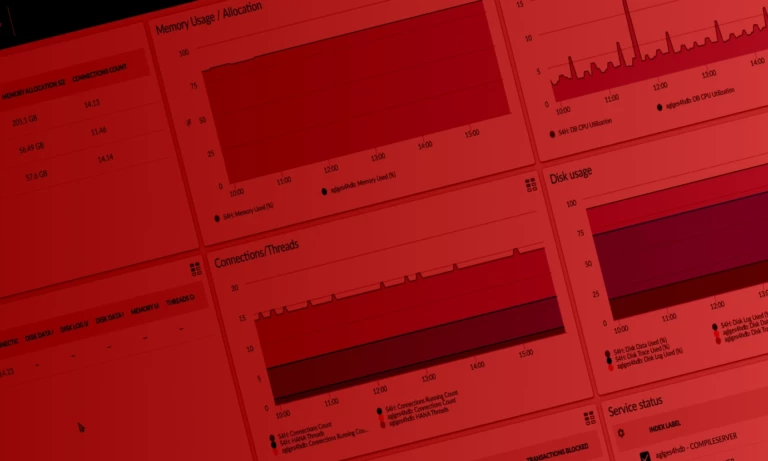
Observability in a hybrid SAP context means having correlated, cross-system telemetry available in a single view: application metrics, database performance, interface health, background job execution, cloud service availability, and business process KPIs. Without that correlation, root cause analysis in a hybrid landscape is guesswork.
What full-stack SAP observability looks like in practice
Full-stack observability for a hybrid SAP landscape covers several distinct layers, each contributing different signal types that are only useful in combination.
At the infrastructure layer, compute, memory, storage I/O, and network latency metrics establish the baseline environment for everything above. At the SAP HANA layer, real-time metrics on memory allocation, statement execution times, lock waits, and replication status provide the performance context for application behavior. At the NetWeaver or S/4HANA application layer, work process load, short dumps, update task health, and dialog response times indicate application-level stability. At the integration layer, interface queue depths, retry counts, error rates, and message processing latency reveal whether the connective tissue between systems is holding.
Business process monitoring adds a final, critical layer. A technically healthy system that is executing the wrong business logic posting incorrect journal entries, failing to trigger procurement workflows is not a healthy system from the business perspective. Monitoring that extends to business process KPIs connects technical health to operational outcomes in a way that infrastructure metrics alone cannot.
Instrumentation considerations before go-live
Observability that is added reactively after the first major incident is observability that arrives too late. The instrumentation decisions made during architecture design and pre-go-live preparation determine what is visible during production operations and what remains a blind spot.
Several instrumentation principles are worth establishing early. First, monitoring should be agentless where possible deploying agents across a distributed SAP landscape adds operational overhead and creates maintenance dependencies that compound over time. Agentless approaches that connect via standard SAP APIs reduce this burden significantly. Second, alert thresholds should be set against measured baselines, not arbitrary defaults. A threshold that has no relation to actual system behavior will either generate noise or miss genuine issues. Third, dashboards should be built for the operational teams that will use them MSP engineers, SAP Basis teams, and business process owners have different information needs and should not have to share the same view.
Finally, observability infrastructure should be tested during the migration window and load testing phases, not just enabled at go-live. The data collected during pre-production activities is valuable for tuning, and the practice of using the monitoring tools before they are needed in a crisis situation improves response quality when it matters.
Building a resilient SAP architecture that holds over time
Resilient SAP landscapes for hybrid cloud and S/4HANA are not built by following a single deployment guide. They result from consistent architectural decisions made across four areas: how workloads are separated and protected, how integration is designed to survive change, how the migration to cloud is handled without creating new blind spots, and how observability is embedded into the architecture from the start rather than added as an afterthought.
Each of these areas involves trade-offs, and the right choices depend on the specific mix of on-premise and cloud components, the criticality of the workloads involved, and the operational maturity of the teams managing the landscape. What does not change is the principle: resilience is designed in, not bolted on.
As SAP landscapes grow more distributed with more workloads moving to RISE with SAP, more extensions built on BTP, and more integration with non-SAP cloud services the gap between architectures designed for resilience and those that are not will widen. The time to close that gap is during the design phase, not during the post-incident review.
Explore how Redpeaks delivers end-to-end observability for hybrid SAP and S/4HANA landscapes.